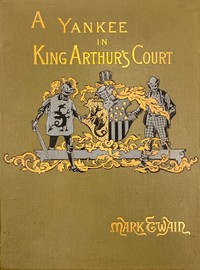
by
MARK TWAIN
(Samuel L. Clemens)
PREFACE
The ungentle laws and customs touched upon in this tale are
historical, and the episodes which are used to illustrate them
are also historical. It is not pretended that these laws and
customs existed in England in the sixth century; no, it is only
pretended that inasmuch as they existed in the English and other
civilizations of far later times, it is safe to consider that it is
no libel upon the sixth century to suppose them to have been in
practice in that day also. One is quite justified in inferring
that whatever one of these laws or customs was lacking in that
remote time, its place was competently filled by a worse one.
The question as to whether there is such a thing as divine right
of kings is not settled in this book. It was found too difficult.
That the executive head of a nation should be a person of lofty
character and extraordinary ability, was manifest and indisputable;
that none but the Deity could select that head unerringly, was
also manifest and indisputable; that the Deity ought to make that
selection, then, was likewise manifest and indisputable; consequently,
that He does make it, as claimed, was an unavoidable deduction.
I mean, until the author of this book encountered the Pompadour,
and Lady Castlemaine, and some other executive heads of that kind;
these were found so difficult to work into the scheme, that it
was judged better to take the other tack in this book (which
must be issued this fall), and then go into training and settle
the question in another book. It is, of course, a thing which
ought to be settled, and I am not going to have anything particular
to do next winter anyway.
MARK TWAIN
HARTFORD, July 21, 1889
A CONNECTICUT YANKEE IN KING ARTHUR’S COURT
A WORD OF EXPLANATION
It was in Warwick Castle that I came across the curious stranger
whom I am going to talk about. He attracted me by three things:
his candid simplicity, his marvelous familiarity with ancient armor,
and the restfulness of his company–for he did all the talking.
We fell together, as modest people will, in the tail of the herd
that was being shown through, and he at once began to say things
which interested me. As he talked along, softly, pleasantly,
flowingly, he seemed to drift away imperceptibly out of this world
and time, and into some remote era and old forgotten country;
and so he gradually wove such a spell about me that I seemed
to move among the specters and shadows and dust and mold of a gray
antiquity, holding speech with a relic of it! Exactly as I would
speak of my nearest personal friends or enemies, or my most familiar
neighbors, he spoke of Sir Bedivere, Sir Bors de Ganis, Sir Launcelot
of the Lake, Sir Galahad, and all the other great names of the
Table Round–and how old, old, unspeakably old and faded and dry
and musty and ancient he came to look as he went on! Presently
he turned to me and said, just as one might speak of the weather,
or any other common matter–
“You know about transmigration of souls; do you know about
transposition of epochs–and bodies?”
I said I had not heard of it. He was so little interested–just
as when people speak of the weather–that he did not notice
whether I made him any answer or not. There was half a moment
of silence, immediately interrupted by the droning voice of the
salaried cicerone:
“Ancient hauberk, date of the sixth century, time of King Arthur
and the Round Table; said to have belonged to the knight Sir Sagramor
le Desirous; observe the round hole through the chain-mail in
the left breast; can’t be accounted for; supposed to have been
done with a bullet since invention of firearms–perhaps maliciously
by Cromwell’s soldiers.”
My acquaintance smiled–not a modern smile, but one that must
have gone out of general use many, many centuries ago–and muttered
apparently to himself:
“Wit ye well, _I saw it done_.” Then, after a pause, added:
“I did it myself.”
By the time I had recovered from the electric surprise of this
remark, he was gone.
All that evening I sat by my fire at the Warwick Arms, steeped
in a dream of the olden time, while the rain beat upon the windows,
and the wind roared about the eaves and corners. From time to
time I dipped into old Sir Thomas Malory’s enchanting book, and
fed at its rich feast of prodigies and adventures, breathed in
the fragrance of its obsolete names, and dreamed again. Midnight
being come at length, I read another tale, for a nightcap–this
which here follows, to wit:
HOW SIR LAUNCELOT SLEW TWO GIANTS, AND MADE A CASTLE FREE
Anon withal came there upon him two great giants, well armed, all save the
heads, with two horrible clubs in their hands. Sir Launcelot put his shield
afore him, and put the stroke away of the one giant, and with his sword he
clave his head asunder. When his fellow saw that, he ran away as he were
wood [*demented], for fear of the horrible strokes, and Sir Launcelot after
him with all his might, and smote him on the shoulder, and clave him to the
middle. Then Sir Launcelot went into the hall, and there came afore him
three score ladies and damsels, and all kneeled unto him, and thanked God
and him of their deliverance. For, sir, said they, the most part of us have
been here this seven year their prisoners, and we have worked all manner of
silk works for our meat, and we are all great gentle-women born, and blessed
be the time, knight, that ever thou wert born; for thou hast done the most
worship that ever did knight in the world, that will we bear record, and we
all pray you to tell us your name, that we may tell our friends who
delivered us out of prison. Fair damsels, he said, my name is Sir Launcelot
du Lake. And so he departed from them and betaught them unto God. And then
he mounted upon his horse, and rode into many strange and wild countries,
and through many waters and valleys, and evil was he lodged. And at the
last by fortune him happened against a night to come to a fair courtilage,
and therein he found an old gentle-woman that lodged him with a good-will,
and there he had good cheer for him and his horse. And when time was, his
host brought him into a fair garret over the gate to his bed. There Sir
Launcelot unarmed him, and set his harness by him, and went to bed, and anon
he fell on sleep. So, soon after there came one on horseback, and knocked at
the gate in great haste. And when Sir Launcelot heard this he rose up, and
looked out at the window, and saw by the moonlight three knights come riding
after that one man, and all three lashed on him at once with swords, and
that one knight turned on them knightly again and defended him. Truly, said
Sir Launcelot, yonder one knight shall I help, for it were shame for me to
see three knights on one, and if he be slain I am partner of his death. And
therewith he took his harness and went out at a window by a sheet down to
the four knights, and then Sir Launcelot said on high, Turn you knights unto
me, and leave your fighting with that knight. And then they all three left
Sir Kay, and turned unto Sir Launcelot, and there began great battle, for
they alight all three, and strake many strokes at Sir Launcelot, and
assailed him on every side. Then Sir Kay dressed him for to have holpen Sir
Launcelot. Nay, sir, said he, I will none of your help, therefore as ye
will have my help let me alone with them. Sir Kay for the pleasure of the
knight suffered him for to do his will, and so stood aside. And then anon
within six strokes Sir Launcelot had stricken them to the earth.
And then they all three cried, Sir Knight, we yield us unto you as man of
might matchless. As to that, said Sir Launcelot, I will not take your
yielding unto me, but so that ye yield you unto Sir Kay the seneschal, on
that covenant I will save your lives and else not. Fair knight, said they,
that were we loath to do; for as for Sir Kay we chased him hither, and had
overcome him had ye not been; therefore, to yield us unto him it were no
reason. Well, as to that, said Sir Launcelot, advise you well, for ye may
choose whether ye will die or live, for an ye be yielden, it shall be unto
Sir Kay. Fair knight, then they said, in saving our lives we will do as
thou commandest us. Then shall ye, said Sir Launcelot, on Whitsunday next
coming go unto the court of King Arthur, and there shall ye yield you unto
Queen Guenever, and put you all three in her grace and mercy, and say that
Sir Kay sent you thither to be her prisoners. On the morn Sir Launcelot
arose early, and left Sir Kay sleeping; and Sir Launcelot took Sir Kay’s
armor and his shield and armed him, and so he went to the stable and took
his horse, and took his leave of his host, and so he departed. Then soon
after arose Sir Kay and missed Sir Launcelot; and then he espied that he had
his armor and his horse. Now by my faith I know well that he will grieve
some of the court of King Arthur; for on him knights will be bold, and deem
that it is I, and that will beguile them; and because of his armor and
shield I am sure I shall ride in peace. And then soon after departed Sir
Kay, and thanked his host.
As I laid the book down there was a knock at the door, and my
stranger came in. I gave him a pipe and a chair, and made him
welcome. I also comforted him with a hot Scotch whisky; gave him
another one; then still another–hoping always for his story.
After a fourth persuader, he drifted into it himself, in a quite
simple and natural way:
THE STRANGER’S HISTORY
I am an American. I was born and reared in Hartford, in the State
of Connecticut–anyway, just over the river, in the country. So
I am a Yankee of the Yankees–and practical; yes, and nearly
barren of sentiment, I suppose–or poetry, in other words. My
father was a blacksmith, my uncle was a horse doctor, and I was
both, along at first. Then I went over to the great arms factory
and learned my real trade; learned all there was to it; learned
to make everything: guns, revolvers, cannon, boilers, engines, all
sorts of labor-saving machinery. Why, I could make anything
a body wanted–anything in the world, it didn’t make any difference
what; and if there wasn’t any quick new-fangled way to make a thing,
I could invent one–and do it as easy as rolling off a log. I became
head superintendent; had a couple of thousand men under me.
Well, a man like that is a man that is full of fight–that goes
without saying. With a couple of thousand rough men under one,
one has plenty of that sort of amusement. I had, anyway. At last
I met my match, and I got my dose. It was during a misunderstanding
conducted with crowbars with a fellow we used to call Hercules.
He laid me out with a crusher alongside the head that made everything
crack, and seemed to spring every joint in my skull and made it
overlap its neighbor. Then the world went out in darkness, and
I didn’t feel anything more, and didn’t know anything at all
–at least for a while.
When I came to again, I was sitting under an oak tree, on the
grass, with a whole beautiful and broad country landscape all
to myself–nearly. Not entirely; for there was a fellow on a horse,
looking down at me–a fellow fresh out of a picture-book. He was
in old-time iron armor from head to heel, with a helmet on his
head the shape of a nail-keg with slits in it; and he had a shield,
and a sword, and a prodigious spear; and his horse had armor on,
too, and a steel horn projecting from his forehead, and gorgeous
red and green silk trappings that hung down all around him like
a bedquilt, nearly to the ground.
“Fair sir, will ye just?” said this fellow.
“Will I which?”
“Will ye try a passage of arms for land or lady or for–”
“What are you giving me?” I said. “Get along back to your circus,
or I’ll report you.”
Now what does this man do but fall back a couple of hundred yards
and then come rushing at me as hard as he could tear, with his
nail-keg bent down nearly to his horse’s neck and his long spear
pointed straight ahead. I saw he meant business, so I was up
the tree when he arrived.
He allowed that I was his property, the captive of his spear.
There was argument on his side–and the bulk of the advantage
–so I judged it best to humor him. We fixed up an agreement
whereby I was to go with him and he was not to hurt me. I came
down, and we started away, I walking by the side of his horse.
We marched comfortably along, through glades and over brooks which
I could not remember to have seen before–which puzzled me and
made me wonder–and yet we did not come to any circus or sign of
a circus. So I gave up the idea of a circus, and concluded he was
from an asylum. But we never came to an asylum–so I was up
a stump, as you may say. I asked him how far we were from Hartford.
He said he had never heard of the place; which I took to be a lie,
but allowed it to go at that. At the end of an hour we saw a
far-away town sleeping in a valley by a winding river; and beyond
it on a hill, a vast gray fortress, with towers and turrets,
the first I had ever seen out of a picture.
“Bridgeport?” said I, pointing.
“Camelot,” said he.
My stranger had been showing signs of sleepiness. He caught
himself nodding, now, and smiled one of those pathetic, obsolete
smiles of his, and said:
“I find I can’t go on; but come with me, I’ve got it all written
out, and you can read it if you like.”
In his chamber, he said: “First, I kept a journal; then by and by,
after years, I took the journal and turned it into a book. How
long ago that was!”
He handed me his manuscript, and pointed out the place where
I should begin:
“Begin here–I’ve already told you what goes before.” He was
steeped in drowsiness by this time. As I went out at his door
I heard him murmur sleepily: “Give you good den, fair sir.”
I sat down by my fire and examined my treasure. The first part
of it–the great bulk of it–was parchment, and yellow with age.
I scanned a leaf particularly and saw that it was a palimpsest.
Under the old dim writing of the Yankee historian appeared traces
of a penmanship which was older and dimmer still–Latin words
and sentences: fragments from old monkish legends, evidently.
I turned to the place indicated by my stranger and began to read
–as follows:
THE TALE OF THE LOST LAND


Comments
Loading comments…