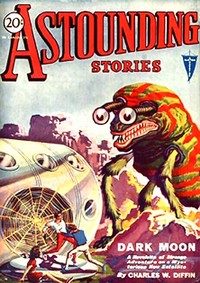
_There Comes a New World_
[Sidenote: Mysterious, dark, out of the unknown deep comes a new
satellite to lure three courageous Earthlings on to strange
adventures.]
The one hundred and fifty-ninth floor of the great Transportation
Building allowed one standing at a window to look down upon the roofs
of the countless buildings that were New York.
Flat-decked, all of them; busy places of hangars and machine shops and
strange aircraft, large and small, that rose vertically under the lift
of flashing helicopters.
The air was alive and vibrant with directed streams of stubby-winged
shapes that drove swiftly on their way, with only a wisp of vapor from
their funnel-shaped sterns to mark the continuous explosion that
propelled them. Here and there were those that entered a shaft of
pale-blue light that somehow outshone the sun. It marked an ascending
area, and there ships canted swiftly, swung their blunt noses upward,
and vanished, to the upper levels.
A mile and more away, in a great shaft of green light from which all
other craft kept clear, a tremendous shape was dropping. Her hull of
silver was striped with a broad red band; her multiple helicopters
were dazzling flashes in the sunlight. The countless dots that were
portholes and the larger observation ports must have held numberless
eager faces, for the Oriental Express served a cosmopolitan passenger
list.
But Walter Harkness, standing at the window, stared out from troubled,
frowning eyes that saw nothing of the kaleidoscopic scene. His back
was turned to the group of people in the room, and he had no thought
of wonders that were prosaic, nor of passengers, eager or blase; his
thoughts were only of freight and of the acres of flat roofs far in
the distance where alternate flashes of color marked the descending
area for fast freighters of the air. And in his mind he could see what
his eyes could not discern–the markings on those roofs that were
enormous landing fields: Harkness Terminals, New York.
* * * * *
Only twenty-four, Walt Harkness–owner now of Harkness, Incorporated.
Dark hair that curled slightly as it left his forehead; eyes that were
taking on the intent, straightforward look that had been his father’s
and that went straight to the heart of a business proposal with
disconcerting directness. But the lips were not set in the hard lines
that had marked Harkness Senior; they could still curve into boyish
pleasure to mark the enthusiasm that was his.
He was not typically the man of business in his dress. His broad
shoulders seemed slender in the loose blouse of blue silk; a narrow
scarf of brilliant color was loosely tied; the close, full-length
cream-colored trousers were supported by a belt of woven metal, while
his shoes were of the coarse-mesh fabric that the latest mode
demanded.
He turned now at the sound of Warrington’s voice. E. B. Warrington,
Counsellor at Law, was the name that glowed softly on the door of
this spacious office, and Warrington’s gray head was nodding as he
dated and indexed a document.
“June twentieth, nineteen seventy-three,” he repeated; “a lucky day
for you, Walter. Inside of ten years this land will be worth double
the fifty million you are paying–and it is worth more than that to
you.”
He turned and handed a document to a heavy-bodied man across from him.
“Here is your copy, Herr Schwartzmann,” he said. The man pocketed the
paper with a smile of satisfaction thinly concealed on his dark face.
* * * * *
Harkness did not reply. He found little pleasure in the look on
Schwartzmann’s face, and his glance passed on to a fourth man who sat
quietly at one side of the room.
Young, his tanned face made bronze by contrast with his close-curling
blond hair, there was no need of the emblem on his blouse to mark him
as of the flying service. Beside the spread wings was the triple star
of a master pilot of the world; it carried Chet Bullard past all
earth’s air patrols and gave him the freedom of every level.
Beside him a girl was seated. She rose quickly now and came toward
Harkness with outstretched hand. And Harkness found time in the
instant of her coming to admire her grace of movement, and the
carriage that was almost stately.
The mannish attire of a woman of business seemed almost a discordant
note; he did not realize that the hard simplicity of her costume had
been saved by the soft warmth of its color, and by an indefinable,
flowing line in the jacket above the rippling folds of an undergarment
that gathered smoothly at her knees. He knew only that she made a
lovely picture, surprisingly appealing, and that her smile was a
compensation for the less pleasing visage of her companion,
Schwartzmann.
“Mademoiselle Vernier,” Herr Schwartzmann had introduced her when they
came. And he had used her given name as he added: “Mademoiselle Diane
is somewhat interested in our projects.”
She was echoing Warrington’s words as she took Harkness’ hand in a
friendly grasp. “I hope, indeed, that it is the lucky day for you,
Monsieur. Our modern transportation–it is so marvelous, and I know so
little of it. But I am learning. I shall think of you as developing
your so-splendid properties wonderfully.”
* * * * *
Only when she and Schwartzmann were gone did Harkness answer his
counsellor’s remark. The steady Harkness eyes were again wrinkled
about with puckering lines; the shoulders seemed not so square as
usual.
“Lucky?” he said. “I hope you’re right. You were Father’s attorney for
twenty years–your judgment ought to be good; and mine is not entirely
worthless.
“Yes, it is a good deal we have made–of course it is!–it bears every
analysis. We need that land if we are to expand as we must, and the
banks will carry me for the twenty million I can’t swing. But,
confound it, Warrington, I’ve had a hunch–and I’ve gone against it.
Schwartzmann has tied me up for ready cash, and he represents the
biggest competitors we have. They’re planning something–but we need
the land…. Oh, well, I’ve signed up; the property is mine; but….”
The counsellor laughed. “You need a change,” he said; “I never knew
you to worry before. Why don’t you jump on the China Mail this
afternoon; it connects with a good line out of Shanghai. You can be
tramping around the Himalayas to-morrow. A day or two there will fix
you up.”
“Too busy,” said Harkness. “Our experimental ship is about ready, so
I’ll go and play with that. We’ll be shooting at the moon one of these
days.”
“The moon!” the other snorted. “Crazy dreams! McInness tried it, and
you know what happened. He came back out of control–couldn’t check
his speed against the repelling area–shot through and stripped his
helicopters off against the heavy air. And that other fellow,
Haldgren–“
“Yes,” said Harkness quietly, “Haldgren–he didn’t fall back. He went
on into space.”
* * * * *
“Impossible!” the counsellor objected. “He must have fallen unobserved.
No, no, Walter; be reasonable. I do not claim to know much about those
things–I leave them to the Stratosphere Control Board–but I do know this
much: that the lifting effect above the repelling area–what used to be
known as the heaviside layer–counteracts gravity’s pull. That’s why our
ships fly as they please when they have shot themselves through. But they
have to fly close to it; its force is dissipated in another ten thousand
feet, and the old earth’s pull is still at work. It can’t be done, my boy;
the vast reaches of space–“
“Are the next to be conquered,” Harkness broke in. “And Chet and I
intend to be in on it.” He glanced toward the young flyer, and they
exchanged a quiet smile.
“Remember how my father was laughed at when he dared to vision the
commerce of to-day? Crazy dreams, Warrington? That’s what they said
when Dad built the first unit of our plant, the landing stages for the
big freighters, the docks for ocean ships while they lasted, the
berths for the big submarines that he knew were coming. They jeered at
him then. ‘Harkness’ Folly,’ the first plant was called. And
now–well you know what we are doing.”
He laughed softly. “Leave us our crazy dreams, Warrington,” he
protested; “sometimes those dreams come true…. And I’ll try to
forget my hunch. We’ve bought the property; now we’ll make it earn
money for us. I’ll forget it now, and work on my new ship. Chet and I
are about ready for a try-out.”
* * * * *
The flyer had risen to join him, and the two turned together to the
door where a private lift gave access to the roof. They were halfway
to it when the first shock came to throw the two men on the floor.
The great framework of the Transportation Building was swaying wildly
as they fell, and the groaning of its wrenched and straining members
sounded through the echoing din as every movable object in the room
came crashing down.
Dazed for the moment, Harkness lay prone, while his eyes saw the
nitron illuminator, like a great chandelier, swing widely from the
ceiling where it was placed. Its crushing weight started toward him,
but a last swing shot it past to the desk of the counsellor.
Harkness got slowly to his feet. The flyer, too, was able to stand,
though he felt tenderly of a bruised shoulder. But where Warrington
had been was only the crumpled wreckage of a steeloid desk, the
shattered bulk of the illuminator upon it, and, beneath, the mangled
remains where flowing blood made a quick pool upon the polished floor.
Warrington was dead–no help could be rendered there–and Harkness was
reaching for the door. The shock had passed, and the building was
quiet, but he shouted to the flyer and sprang into the lift.
“The air is the place for us,” he said; “there may be more coming.” He
jammed over the control lever, and the little lift moved.
“What was it?” gasped Bullard, “earthquake?–explosion? Lord, what a
smash!”
Harkness made no reply. He was stepping out upon the broad surface of
the Transportation Building. He paid no attention to the hurrying
figures about him, nor did he hear the loud shouting of the
newscasting cone that was already bringing reports of the disaster. He
had thought only for the speedy little ship that he used for his daily
travel.
* * * * *
The golden cylinder was still safe in the grip of its hold-down
clutch, and its stubby wings and gleaming sextuple-bladed helicopter
were intact. Harkness sprang for the control-board.
He, too, wore an emblem: a silver circle that marked him a pilot of
the second class; he could take his ship around the world below the
forty level, though at forty thousand and above he must give over
control to the younger man.
The hiss of the releasing clutch came softly to him as the free-signal
flashed, and he sank back with a great sigh of relief as the motors
hummed and the blades above leaped into action. Then the stern blast
roared, though its sound came faintly through the deadened walls, and
he sent the little speedster for the pale blue light of an ascending
area. Nor did he level off until the gauge before him said twenty
thousand.
His first thought had been for their own safety in the air, but with
it was a frantic desire to reach the great plant of the Harkness
Terminals. What had happened there? Had there been any damage? Had
they felt the shock? A few seconds in level twenty would tell him. He
reached the place of alternate flashes where he could descend, and the
little ship fell smoothly down.
Below him the great expanse of buildings took form, and they seemed
safe and intact. His intention was to land, till the slim hands of
Chet Bullard thrust him roughly aside and reached for the controls.
It was Bullard’s right–a master pilot could take control at any
time–but Harkness stared in amazement as the other lifted the ship,
then swung it out over the expanse of ocean beyond–stared until his
own eyes followed those of Chet Bullard to see the wall of water that
was sweeping toward the land.
Chet, he knew, had held them in a free-space level, where they could
maneuver as they pleased, but he knew, too, that the pilot’s hands
were touching levers that swung them at a quite unlawful speed past
other ships, and that swept them down in a great curve above the
ocean’s broad expanse.
* * * * *
Harkness did not at once grasp the meaning of the thing. There was the
water, sparkling clear, and a monstrous wave that lifted itself up to
mountainous heights. Behind it the ocean’s blue became a sea of mud;
and only when he glanced at their ground-speed detector did he sense
that the watery mountain was hurling itself upon the shore with the
swiftness of a great super-liner.
There were the out-thrusting capes that made a safe harbor for the
commerce that came on and beneath the waters to the Harkness
Terminals; the wave built itself up to still greater heights as it
came between them. They were riding above it by a thousand feet, and
Walter Harkness, in sudden knowledge of what this meant, stared with
straining eyes at the wild thing that raced with them underneath.
He must do something–anything!–to check the monster, to flatten out
the onrushing mountain! The red bottom-plates of a submarine freighter
came rolling up behind the surge to show how futile was the might of
man. And the next moment marked the impact of the wall of water upon a
widespread area of landing roofs, where giant letters stared mockingly
at him to spell the words: Harkness Terminals, New York.
He saw the silent crumbling of great buildings; he glimpsed in one
wild second the whirling helicopters on giant freighters that took the
air too late; he saw them vanish as the sea swept in and engulfed
them. And then, after endless minutes, he knew that Chet had swung
again above the site of his plant, and he saw the stumps of steel and
twisted wreckage that remained….
* * * * *
The pilot hung the ship in air–a golden beetle, softly humming as it
hovered above the desolate scene. Chet had switched on the steady buzz
of the stationary-ship signal, and the wireless warning was swinging
passing craft out and around their station. Within the quiet cabin a
man stood to stare and stare, unspeaking, until his pilot laid a
friendly hand upon the broad shoulders.
“You’re cleaned,” said Chet Bullard. “It’s a washout! But you’ll build
it up again; they can’t stop you–“
But the steady, appraising eyes of Walter Harkness had moved on and on
to a rippling stretch of water where land had been before.
“Cleaned,” he responded tonelessly; “and then some! And I could start
again, but–” He paused to point to the stretch of new sea, and his
lips moved that he might laugh long and harshly. “But right there is
all I own–that is, the land I bought this morning. It is gone, and I
owe twenty million to the hardest-hearted bunch of creditors in the
world. That foreign crowd, who’ve been planning to invade our
territory here. You know what chance I’ll have with them….”
The disaster was complete, and Walter Harkness was facing it–facing
it with steady gray eyes and a mind that was casting a true balance of
accounts. He was through, he told himself; his other holdings would be
seized to pay for this waste of water that an hour before had been dry
land; they would strip him of his last dollar. His lips curved into a
sardonic smile.
“June twentieth, nineteen seventy-three,” he repeated. “Poor old
Warrington! He called this my lucky day!”
* * * * *
The pilot had respected the other man’s need of silence, but his
curiosity could not be longer restrained.
“What’s back of it all?” he demanded. “What caused it? The shock was
like no earthquake I’ve ever known. And this tidal wave–” He was
reaching for a small switch. He turned a dial to the words: “News
Service–General,” and the instrument broke into hurried speech.
It told of earth shocks in many places–the whole world had felt
it–some tremendous readjustment among the inner stresses of the
earth–most serious on the Atlantic seaboard–the great Harkness
Terminals destroyed–some older buildings in the business district
shaken down–loss of life not yet computed….
“But what _did_ it?” Chet Bullard was repeating in the cabin of their
floating ship. “A tremendous shake-up like that!” Harkness silenced
him with a quick gesture of his hand. Another voice had broken in to
answer the pilot’s question.
“The mystery is solved,” said the new voice. “This is the Radio-News
representative speaking from Calcutta. We are in communication with
the Allied Observatories on Mount Everest. At eleven P. M., World
Standard Time, Professor Boyle observed a dark body in transit across
the moon. According to Boyle, a non-luminous and non-reflecting
asteroid has crashed into the earth’s gravitational field. A dark moon
has joined this celestial grouping, and is now swinging in an orbit
about the earth. It is this that has disturbed the balance of internal
stresses within the earth–“
* * * * *
“A dark moon!” Chet Bullard broke in, but again a movement from
Harkness silenced his exclamations. Whatever of dull apathy had
gripped young Harkness was gone. No thought now of the devastation
below them that spelled his financial ruin. Some greater, more
gripping idea had now possessed him. The instrument was still
speaking:
“–Without light of its own, nor does it reflect the sun’s light as
does our own moon. This phenomenon, as yet, is unexplained. It is
nearer than our own moon and smaller, but of tremendous density.”
Harkness nodded his head quickly at that, and his eyes were alive with
an inner enthusiasm not yet expressed in words. “It is believed that
the worst is over. More minor shocks may follow, but the cause is
known; the mystery is solved. Out from the velvet dark of space has
come a small, new world to join us–“
The voice ceased. Walter Harkness had opened the switch.
“The mystery is solved,” Chet Bullard repeated.
“Solved?” exclaimed the other from his place at the controls. “Man, it
is only begun!” He depressed a lever, and a muffled roar marked their
passage to a distant shaft of blue, where he turned the ship on end
and shot like a giant shell for the higher air.
There was northbound travel at thirty-five, and northward Harkness
would go, but he shot straight up. At forty thousand he motioned the
master-pilot to take over the helm.
“Clear through,” he ordered; “up into the liner lanes; then north for
our own shop.” Nor did he satisfy the curiosity in Chet Bullard’s eyes
by so much as a word until some hours later when they floated down.
* * * * *
An icy waste was beneath them, where the sub-polar regions were
wrapped in the mantle of their endless winter. Here ships never
passed. Northward, toward the Pole, were liner lanes in the higher
levels, but here was a deserted sector. And here Walter Harkness had
elected to carry on his experiments.
A rise of land showed gaunt and black, and the pilot was guiding the
ship in a long slant upon it. He landed softly beside a building in a
sheltered, snow-filled valley.
Harkness shivered as he stepped from the warmth of their insulated
cabin, and he fumbled with shaking fingers to touch the combination
upon the locked door. It swung open, to close behind the men as they
stood in the warm, brightly-lighted room.
Nitro illuminators were hung from the ceiling, their diffused
brilliance shining down to reflect in sparkling curves and ribbons of
light from a silvery shape. It stood upon the floor, a metal cylinder
a hundred feet in length, whose blunt ends showed dark openings of
gaping ports. There were other open ports above and below and in
regular spacing about the rounded sides. No helicopters swung their
blades above; there were only the bulge of a conning tower and the
heavy inset glasses of the lookouts. Nor were there wings of any kind.
It might have been a projectile for some mammoth gun.
Harkness stood in silence before it, until he turned to smile at the
still-wondering pilot.
“Chet,” he said, “it’s about finished and ready–just in time. We’ve
built it, you and I; freighted in the parts ourselves and assembled
every piece. We’ve even built the shop: lucky the big steeloid plates
are so easily handled. And you and I are the only ones that know.
“Every ship in the airlanes of the world is driven by detonite–and we
have evolved a super-detonite. We have proved that it will work. It
will carry us beyond the pull of gravitation; it will give us the
freedom of outer space. It is ours and ours alone.”
“No,” the other corrected slowly, “it is yours. You have paid the
bills and you have paid me. Paid me well.”
“I’m paying no more,” Harkness told him. “I’m broke, right this
minute. I haven’t a dollar–and yet I say now that poor Warrington was
right: this is my lucky day.”
* * * * *
He laughed aloud at the bewilderment on the pilot’s face.
“Chet,” he said slowly, and his voice was pitched to a more serious
tone, “out there is a new world, the Dark Moon. ‘Tremendous density,’
they said. That means it can hold an atmosphere of its own. It means
new metals, new wealth. It means a new little world to explore, and
it’s out there waiting for us. Waiting for us; we will be the first.
For here is the ship that will take us.
“It isn’t mine, Chet; it’s ours. And the adventure is ours; yours and
mine, both. We only meant to go a few hundred miles at first, but
here’s something big. We may never come back–it’s a long chance that
we’re taking–but you’re in on it, if you want to go….”
He paused. The expression in the eyes of Chet Bullard, master-pilot of
the world, was answer enough. But Chet amplified it with explosive
words.
“Am I in on it?” he demanded. “Try to count me out–just try to do it!
I was game for a trial flight out beyond. And now, with a real
objective to shoot at–a new world–“
His words failed him. Walt Harkness knew that the hand the other
extended was thrust forth blindly; he gripped at it hard, while he
turned to look at the shining ship.
But his inner gaze passed far beyond the gleaming thing of metal, off
into a realm of perpetual night. Out there a new world was waiting–a
Dark Moon!–and there they might find…. But his imagination failed
him there; he could only thrill with the adventure that the unknown
held.




Comments
Loading comments…