Distributed Proofreading Team at http://www.pgdp.net
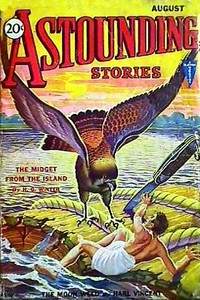
ASTOUNDING
STORIES
20¢
_On Sale the First Thursday of Each Month_
W. M. CLAYTON, Publisher
HARRY BATES, Editor
The Clayton Standard on a Magazine Guarantees
_That_ the stories therein are clean, interesting, vivid, by leading
writers of the day and purchased under conditions approved by
the Authors’ League of America;
_That_ such magazines are manufactured in Union shops by American
workmen;
_That_ each newsdealer and agent is insured a fair profit;
_That_ an intelligent censorship guards their advertising pages.
_The other Clayton magazines are:_
ACE-HIGH MAGAZINE, RANCH ROMANCES, COWBOY STORIES, CLUES, FIVE-NOVELS
MONTHLY, ALL STAR DETECTIVE STORIES, RANGELAND LOVE STORY MAGAZINE,
WESTERN ADVENTURES, WESTERN LOVE STORIES and JUNGLE STORIES.
_More than Two Million Copies Required to Supply the Monthly Demand
for Clayton Magazines._
* * * * *
VOL. VII, No. 2 CONTENTS AUGUST, 1931
THE DANGER FROM THE DEEP RALPH MILNE FARLEY 149
_Marooned on the Sea-Floor, His Hoisting Cable Cut, Young Abbot Is
Left at the Mercy of the Man-Sharks._
BROOD OF THE DARK MOON CHARLES WILLARD DIFFIN 168
_Once More Chet, Walt and Diane Are United in a Wild Ride to the Dark
Moon. But This Time They Go as Prisoners of Their Deadly Enemy
Schwartzmann._ (Beginning a Four-Part Novel.)
IF THE SUN DIED R. F. STARZL 198
_Tens of Millenniums After the Death of the Sun There Comes a Young
Man Who Dares to Open the Frozen Gate of Subterranea._
THE MIDGET FROM THE ISLAND H. G. WINTER 214
_Garth Howard, Prey to Half the Animals of the Forest, Fights Valiantly
to Regain His Lost Five Feet of Size._ (A Complete Novelette.)
THE MOON WEED HARL VINCENT 236
_Unwittingly the Traitor of the Earth, Van Pits Himself Against the
Inexorably Tightening Web of Plant-Beasts He Has Released from the
Moon._
THE PORT OF MISSING PLANES CAPTAIN S. P. MEEK 255
_In the Underground Caverns of the Selom, Dr. Bird Once Again Locks
Wills with the Subversive Genius, Saranoff._
THE READERS CORNER ALL OF US 273
_A Meeting Place for Readers of Astounding Stories_
* * * * *
Single Copies, 20 Cents (In Canada, 25 Cents) Yearly Subscription, $2.00
Issued monthly by The Clayton Magazines, Inc., 80 Lafayette Street,
New York, N. Y. W. M. Clayton, President; Francis P. Pace, Secretary.
Entered as second-class matter December 7, 1929, at the Post Office at
New York, N. Y., under Act of March 3, 1879. Title registered as a
Trade Mark in the U. S. Patent Office. Member Newsstand Group. For
advertising rates address The Newsstand Group, Inc., 80 Lafayette
Street, New York; or The Wrigley Bldg., Chicago.
* * * * *
The Danger from the Deep
_By Ralph Milne Farley_
[Sidenote: Marooned on the sea-floor, his hoisting cable cut, young
Abbot is left at the mercy of the man-sharks.]
Within a thick-walled sphere of steel eight feet in diameter, with
crystal-clear fused-quartz windows, there crouched an alert young
scientist, George Abbot. The sphere rested on the primeval muck and
slime at the bottom of the Pacific Ocean, one mile beneath the
surface.
The beam from his 200-watt searchlight, which shot out through one of
his three windows into the dark blue depths beyond, seemed faint
indeed, yet it served to illuminate anything which crossed it, or on
which it fell.
For a considerable length of time since his descent to the ocean
floor, young Abbot had clung to one of the thick windows of his
bathysphere, absorbed by the marine life outside. Slender small fish
with stereoscopic eyes, darted in and out of the beam of light.
Swimming snails floated by, carrying their own phosphorescent
lanterns. Paper-thin transparent crustaceans swam into view, followed
by a few white shrimps, pale as ghosts. Then a mist of tiny fish swept
across his field of vision. Abbot cupped his face in his hands, and
stared out.
The incongruous thought flashed across his mind that thus he had often
sat by the window of his club in New York, and gazed out at the
passing motor traffic.
His searchlight cut a sharp swath through the blue muck. More than
once he thought he saw large moving fish-like forms far away.
“Speed up the generator,” he called into his phone.
Immediately the shaft of light brightened. He set about trying to
focus upon one of those dim elusive shapes which had so intrigued him.
* * * * *
But suddenly the searchlight went out! Intent on repairing the
apparatus as rapidly as possible, Abbot snapped the button-switch,
which ought to have illuminated the interior of his diving-sphere; but
the lights did not go on. Then he noticed that the electric fan, on
which he depended to keep his air-supply properly mixed, had stopped.
He spoke into the telephone transmitter, which hung in front of his
mouth: “Hi, there, up on the boat! My electric power is cut off. I’m
down here with my fan stopped and my heat cut off. Hoist me up, and be
quick about it!”
“O.K., sir.”
As the young man waited for the winch to get under way on the boat a
mile above him, he pulled out his electric pocket flashlight and sent
its feeble ray out through his quartz-glass window into the dim
royal-purple depths beyond, in one last attempt to get a look at those
mysterious fish-shapes which had so intrigued him.
And then he saw one of them distinctly.
Evidently they had swum closer when the glow of his searchlight had
stopped; and so the sudden flash of his pocket-light had taken them by
surprise.
For, as he snapped it on, he caught an instant’s glimpse of a grinning
fish-face pressed close against the outside of his thick window-pane,
as though trying to peer in at him. The fish-face somewhat resembled
the head of a shark, except that the mouth was a bit smaller and not
quite so leeringly brutal, and the forehead was rather high and domed.
But what most attracted Abbot’s attention, in the brief instant before
the startled fish whisked away in a swirl of phosphorescent foam, was
the fact that, from beneath each of the two pectoral fins, there
protruded what appeared to be a skinny human arm, terminating in three
fingers and a thumb!
Then the fish was gone. Abbot snapped off his little light.
The diving-sphere quivered, as the hoisting-cable tautened. But
suddenly the sphere settled back to the bottom of the sea with a
jarring thud. “Cable’s parted, sir!” spoke a frantic voice in his
ear-phones.
* * * * *
For a moment George Abbot sat stunned with horror. Then his mind began
to race, like a squirrel in a cage, seeking some way of escape.
Perhaps he could manage to unscrew the 400-pound trap door at the top
of the sphere, and shoot to the surface, with the bubbling-out of the
confined air. But his scientifically trained mind made some rapid
calculations which showed him this was absurd.
At the depth of a mile, the pressure is roughly 156 atmospheres, that
is to say, 156 times the air-pressure at the surface of the earth; and
the moment that his sphere was opened to this pressure, he would be
blown back inwardly away from the man-hole, and the air inside his
sphere would suddenly be compressed to only 1/156 of its former
volume.
Not only would this pressure be sufficient to squash him into a
mangled pulp, but also the sudden compression of the air inside the
sphere would generate enough heat to fry that mangled pulp to a crisp
cinder almost instantly.
As George Abbot came to a full realization of the horror of these
facts, he recoiled from the trap-door as though it were charged with
death.
“For Heaven’s sakes, do something!” he shrieked in agony into the
transmitter.
“Courage, sir,” came back the reply. “We are rigging up a grapple just
as fast as we can. Long before your oxygen gives out, we shall slide
it down to you along the telephone line, which is the only remaining
connection between us. When it settles about your sphere, and you can
see its hooks outside your window by the light of your pocket-flash,
let us know, and we’ll trip the grapple and haul you up.”
“Thank you,” replied the young man.
* * * * *
He was calm now, but it was an enforced and numb kind of calmness.
Mechanically he throttled down his oxygen supply, so as to make it
last longer. Mechanically he took out his notebook and pencil and
started to write down, in the dark, his experiences; for he was
determined to leave a full account for posterity, even though he
himself should perish.
After setting down a categorical description of the successive
partings of the electric light cable and the hoist cable, and his
thoughts and feelings in that connection, he described in detail the
shark with hands, which he had seen through the window of his sphere.
He tried to be very explicit about this, for he realized that his
account would probably be laid, by everyone, to the disordered
imagination of his last dying moments; being a true scientist, George
Abbot wanted the world to believe him, so that another sphere would be
built and sent down to the ocean depths, to find out more about these
peculiar denizens of the deep.
Of course, no one would believe him. This thought kept drumming in his
ears. No one–except Professor Osborne. Old Osborne would believe!
George Abbot’s mind flashed back to a conversation he had had with the
old professor, just before the oil interests had sent him on this
exploring trip to discover the source of the large quantities of
petroleum which had begun to bubble up from the bottom of a certain
section of the Pacific very near where Abbot now was.
* * * * *
Osborne had said, “This petroleum suggests a gusher to me. And what
causes gushers? Human beings, boring for oil, to satisfy human needs.”
“But, Professor,” Abbot had objected, “there can’t be any human beings
at the bottom of the sea!”
“Why not?” Professor Osborne had countered. “Life is supposed to have
originated spontaneously in the slime of the ocean depths; therefore
that part of the earth has had a head-start on us in the game of
evolution. May not this head-start have been maintained right down to
date, thus producing at the bottom of the sea a race superior to
anything upon the dry land?”
“But,” Abbot had objected further, “if so, why haven’t they come up to
visit or conquer us? And why haven’t we ever found any trace of them?”
“Quite simple to explain,” the old professor had replied. “Any
creature who can live at the frightful pressures of the ocean depths
could never survive a journey even halfway to the surface. It would be
like our trying to live in an almost perfect vacuum. We should
explode, and so would these denizens of the deep, if they tried to
come up here. Even one of their dead bodies could not be brought to
the surface in recognizable form. No contact with them will ever be
possible, nor will they ever constitute a menace to any one–for which
we may thank the Lord!”
George Abbot now reviewed this conversation as he crouched in his
diving-sphere in the purple darkness of the marine depths. Yes, old
Osborne would believe him. The diary must be written for Osborne’s
eyes.
* * * * *
Abbot sent another beam from his pocket light suddenly out into the
water; and this time he surprised several of the peculiar fish. These,
like the first, had arms and hands and high intelligent foreheads.
Then suddenly Abbot laughed a harsh laugh. Old Osborne had been wrong
in one thing, namely in saying that the super-race of the deep would
never be a menace to anyone. They were being a menace to George Abbot,
right now, for it was undoubtedly they who had cut his cables.
Probably they were possessed of much the same scientific curiosity
with regard to him as he was with regard to them, and so they had
determined to secure him as a museum specimen.
The idea was a weird one. He laughed again, mirthlessly.
“What is the matter, sir?” came an anxious voice in his ear-phones.
“Hurry that grapple!” was his reply. “I have found out what cut my
cables. There are some very intelligent-looking fish down here, and I
think they want me for–“
An ominous click sounded in his ears. Then silence.
“Hello! Hello there!” he shouted. “Can you hear me up on the boat?”
But no answer came back. The line remained dead. The strange fish had
cut George Abbot’s last contact with the upper world. The
grapple-hooks could never find him now, for there was now not even a
telephone cable to guide them down to his sphere.
The realization that he was hopelessly lost, and that he had not much
longer to live, came as a real relief to him, after the last few
moments of frantic uncertainty.
* * * * *
Hoping that his sphere would eventually be found, even though too late
to do him any good, he set assiduously to work jotting down all the
details which he could remember of those strange denizens of the deep,
the man-handed sharks, which he was now firmly convinced were the
cause of his present predicament.
He stared out through one of his windows into the brilliant blue
darkness, but did not turn on his flashlight. How near were these
enemies of his, he wondered?
The presence of those menacing man-sharks, just outside the
four-inch-thick steel shell, which withstood a ton of pressure for
each square inch of its surface, began to obsess young Abbot. What
were they doing out there in the watery-blue midnight? Perhaps, having
secured his sphere as a scientific specimen, they were already
preparing to cut into it so as to see what was inside. That these
fish could cut through four inches of steel was not so improbable as
it sounded, for had they not already succeeded in severing a rubber
cable an inch and a half thick, containing two heavy copper wires, and
also two inches of the finest, non-kinking steel rope!
The young scientist flashed his pocket torch out through the thick
quartz pane, but his enemies were nowhere in sight. Then he fell to
calculating his oxygen supply. His normal consumption was about half a
quart per minute, at which rate his two tanks would be good for
thirty-six hours. His chemical racks contained enough soda-lime to
absorb the excess carbon dioxide, enough calcium chloride to keep down
the humidity and enough charcoal to sweeten the body odors for much
more than that period.
For a moment, the thought of these facts encouraged him. He had been
down less than two hours. Perhaps the boat above him could affect his
rescue in the more than thirty-four hours which remained!
* * * * *
But then he realized that he had failed to take into consideration the
near-freezing temperature of the ocean depths. This temperature he
knew to be in the neighborhood of 39 degrees Fahrenheit–even though
no thermometer hung outside his window, as none could withstand the
frightful pressures at the bottom of the sea. For it is one of the
remarkable facts of inductive science that man has been able to figure
out _a priori_ that the temperature at all deep points of the ocean,
tropic as well as arctic, must always be stable at approximately 39
degrees.
Abbot was clad only in a light cotton sailor suit, and now that his
source of heat had been cut off by the severing of his power lines,
his prison was rapidly becoming unbearably chilly. His thick steel
sphere constituted such a perfect transmitter of heat that he might
almost as well have been actually swimming in water of 39 degrees
temperature, so far as comfort was concerned.
Abbot’s emotions ran all the gamut from stupefaction, through dull
calmness, clear-headed thought, intense but aimless mental activity,
nervousness, frenzy, and insane delirium, back to stupefaction again.
During one of his periods of calmness, he figured out what an almost
total impossibility there was of the chance that his ship, one mile
above him on the surface, could ever find his sphere with grappling
hooks. Yet he prayed for that chance. A single chance in a million
sometimes does happen.
* * * * *
Several hours had by now elapsed since the parting of the young
scientist’s cables. It was bitterly cold inside the sphere. In order
to keep warm, he had to exercise during his calm moments as
systematically as his cramped quarters would permit. During his
frantic moments he got plenty of exercise automatically. And of course
all this movement used up more than the normal amount of oxygen, so
that he was forced to open the valves on his tanks to two or three
times their normal flow. His span of further life was thereby cut to
ten or twelve hours, if indeed he could keep himself warm for that
long.
Why didn’t the people on the boat do something!
He was just about to indulge in one of his frantic fits of despair,
when he heard or felt–the two senses being strangely commingled in
his present situation–a clank or thump upon the top of his
bathysphere. Instantly hope flooded him. Could it be that the one
chance in a million had actually happened, and that a grapple from the
boat above had actually found him?
With feverish expectation, he pressed the button of his little
electric pocket flashlight, and sent its feeble beam out through one
of the quartz-glass windows into the blue-black depths beyond.
No hooks in front of this window. He tried the others. No hooks there,
either. But he did see plenty of the superhuman fish. Eighteen of
them, he counted, in sight at one time. And also two huge snake-like
creatures with crested backs and maned heads, veritable sea-serpents.
As there was nothing the young man could do to assist in the grappling
of his sphere by his friends in the boat above, he devoted his time to
jotting down a detailed description of these two new beasts and of
their behavior.
One of the sharks appeared to be leading or driving them up to the
bathysphere; and when they got close enough, Abbot was surprised to
see that they wore what appeared to be a harness!
* * * * *
The clanking upon the bathysphere continued, and now the young man
learned its cause. It was not the grapple hooks from his ship, but
chains–chains which the man-armed sharks were wrapping around the
bathysphere.
Two more of the harnessed sea-serpents swam into view, and these two
were hitched to a flat cart: an actual cart with wheels. The chains
were attached to the harness of the original two beasts; they swam
upward and disappeared from view; and the sphere slowly rose from the
mucky bottom of the sea, to be lowered again squarely on top of the
cart. The cart jerked forward, and a journey over the ocean floor
began.
Then the little pocket torch dimmed to a dull red glow, and the scene
outside faded gradually from view. Abbot switched off the now useless
light and set to work with scientific precision to record all these
unbelievable events.
In his interest and excitement, he had forgotten the ever-increasing
cold; but gradually, as he wrote, the frigidity of his surroundings
was forced on his consciousness. He turned on more oxygen, and
exercised frantically. Meanwhile the cart, carrying his bathysphere,
bumped along over an uneven road.
From time to time, he tried his almost exhausted little light, but its
dim red beam was completely absorbed by the blue of the ocean depths,
and he could make out nothing except two bulking indistinct shapes,
writhing on ahead of him. Finally even this degree of visibility
failed, and he could see absolutely nothing outside.
He was now so chilled and numb that he could no longer write. With a
last effort, he noted down that fact, and then put the book away in
its rack.
He began to feel drowsy. Rousing himself, he turned on more oxygen.
The effect was exhilaration and a feeling of silly joy. He began to
babble drunkenly to himself. His head swam. His mind was in a daze.
* * * * *
It seemed hours later when he awoke. Ahead of him in the distance
there was a dim pale-blue light, against which there could be seen, in
silhouette, the forms of the two serpentine steeds and their fish-like
drivers. Abbot’s hands and feet were completely numb, but his head was
clear.
As they drew nearer to the light, it gradually took form, until it
turned out to be the mouth of a cave. The cart entered it.
Down a long tunnel they progressed, the light getting brighter and
brighter as they advanced. The color of the light became a golden
green. The rough stone walls of the tunnel could now be seen; and
finally there appeared, ahead, two semicircular doors, swung back
against the sides of the passage.
Beyond these doors, the tunnel walls were smooth and exactly
cylindrical, and on the ceiling there were many luminous tubes, which
lit up the place as brightly as daylight. The cart came to a stop.
The young scientist could now see with surprising distinctness his
captors and their serpentine steeds, and even the details of the
chains and the harness. He tried to pick up his diary, so as to jot
down some points which he had theretofore missed; but his hands were
too numb. But at least he could keep on observing; so he glued his
eyes to the thick quartz window-pane once more.
A short distance ahead in the passage there was another pair of doors.
Presently these swung open and the cavalcade moved forward. Five or
six successive pairs of doors were passed in this manner, and then the
sea-serpents began to thrash about and become almost unmanageable. It
was evident that some change not to their liking had taken place in
their surroundings.
* * * * *
At last, as one of the portals swung open, young Abbot saw what
appeared to be four deep-sea diving-suits. Could these suits contain
human beings? And if so, who? It seemed incredible, for no diving-suit
had ever been devised in which a man could descend to the depth of one
mile, and live.
These four figures, whatever they were, came stolidly forward and took
charge of the cart. One of the sharks swam up to them and appeared to
talk to them with its hands. Then the sharks unhitched the two
sea-serpents and led them to the rear, and Abbot saw them no more.
The four divers picked up the chains, and slowly towed the cart
forward, their clumsy, ponderous movements contrasting markedly with
the swift and sure swishings which had characterized the man-sharks
and their snake-like steeds.
Several more pairs of doors were passed, and then there met them four
figures in less cumbersome diving-suits, like those ordinarily used by
men just below the surface of the sea. One of the deep-sea divers then
pressed his face close to the outside of one of the windows of the
bathysphere, as though to take a look inside; but the four newcomers
waved him away, and hurriedly picked up the chains. Nevertheless, in
that brief instant, Abbot had seen within the head-piece of the diver
what appeared to be a bearded human face.
Several more pairs of doors were passed. The four deep-sea divers
floundered along beside the cart, quite evidently having more and more
difficulty of locomotion as each successive doorway was passed, until
finally they lay down and were left behind.
At last the procession entered a section of tunnel which was square,
instead of circular, and in which there was a wide shelf along one
side about three feet above the floor. The four divers then dropped
the chains, and one by one took a look at Abbot through his window.
And he at the same time took a most interested look at them.
They had unmistakable human faces!
* * * * *
He must be dreaming! For even if Osborne was right about his supposed
super-race at the bottom of the sea, this race could not be human, for
the pressures here would be entirely too great. No human being could
possibly stand two thousand pounds per square inch!
Having satisfied their curiosity, the four divers pulled themselves up
onto the shelf, and sat there in a row with their legs hanging over.
Abbot glanced upward at the ceiling lights, but these had become
strangely blurred. There seemed to be an opaque barrier above him, and
this barrier seemed to be slowly descending. The lights blurred out
completely, and were replaced by a diffused illumination over the
entire ripply barrier. And then it dawned on the young man that this
descending sheet of silver was the surface of the water. He was in a
lock, and the water was being pumped out.
The surface settled about the helmets of the divers, and their helmets
disappeared; then their shoulders and the rest of them. At last it
reached the level of Abbot’s window. The divers could again be seen,
and among then on the shelf there stood a half dozen naked bearded
men, clad only in loin-cloths. They had evidently entered the lock
while the water was subsiding.
* * * * *
These men unbuckled the helmets of the divers and helped them out, and
then splashed down into the water and peered in through the windows of
the bathysphere. Presently some of them left through a door at the end
of the platform, but soon reappeared with staging, which they set up
around the sphere. Then, climbing on top, they got to work on the
man-hole cover.
As George Abbot realized their purpose, he became frantic. Although
these men appeared to be human, just like himself, yet his
scientifically-trained mind told him that they must be of some very
special anatomical structure, in order to be able to withstand the
immense pressures at the bottom of the Pacific. It was all right for
them to be out there, but it would be fatal to him!
And then the heavy circular door above him began slowly to revolve.
This was terrible! In a moment the crushing pressures of the depths
would come seeping in. Rising unsteadily upon his knees, the young man
tried with his fingers to resist the rotation of the door; but it
continued to turn.
Yet no pressure could be felt. The door became completely unscrewed.
It was pried up, and slid off the top of the bathysphere, to crash
upon the floor outside. Inquisitive bearded faces peered down through
the hole.
Young Abbot slumped to the cold bottom of the sphere and stared back
at them. He was saved; incredibly saved! These were real people, the
air was real air and he must therefore be on the surface of the earth,
instead of at the bottom of the Pacific as he had imagined! With a
sigh of relief, he fainted….
* * * * *
When he came to his senses again, he was lying in a bed in a small
room. Bending over him was the sweetest feminine face that he had ever
seen.
The girl seemed to be about twenty years of age. She was clad in a
clinging robe of some filmy green substance. Her hair was honey-brown,
short and curly, and her forehead high and intelligent. Her eyes, an
indescribable shade of deep violet, were matchlessly set off by her
ivory skin.
The young man smiled up at her, and she smiled back. Thus far it had
not occurred to him to wonder where he was, or why. No recollection of
his recent strange adventures came to him. To him this was an exotic
dream, from which he did not care to awake.
She spoke. Her words were unintelligible, and unlike any language
which George Abbot knew or had even heard; and he was an accomplished
linguist in addition to his other attainments.
And her words were not all that was strange about her speech, for the
very tones of her voice sounded completely unhuman, although not
displeasing. Her talk had a metallic ring to it, like the brassy blare
of temple gongs, and yet was so smooth and subdued as to be sweeter
than any sound that the young scientist had ever heard before.
“Beautiful dream fairy,” replied the enraptured young man, “I haven’t
the slightest idea what you are saying, but keep right on. I like it.”
His own voice sounded crass and crude compared to hers. At his first
words she gave a start of surprise, but thereafter the sound did not
appear to grate on her ears.
* * * * *
Then one of the bearded men in loin-cloths entered, and he and the
girl talked together, quite evidently about their patient. The man’s
voice had the same strange metallic quality to it as that of the girl,
but was deeper, so that it boomed with the rich notes of a bell.
At the sight of the man, young Abbot’s memory swept back, and he
remembered the adventure of his diving-sphere, and its capture, one
mile down, by the strange shark-fish with human hands and arms. But
how he had reached the surface of the earth again, he couldn’t figure
out. Nor did he particularly care.
The strange man withdrew, and the girl sat down beside the bed and
smiled at Abbot. He smiled back at her.
Presently another girl entered and called, “Milli!”
The girl beside the bed started, and looking up asked some question,
to which the other replied.
The newcomer brought in some strange warm food in a covered dish and
then withdrew. The first girl proceeded to feed her patient.
After the meal, which tasted unlike anything which the young man had
ever eaten before, the beautiful nurse again essayed conversation with
him. She seemed perplexed and a bit frightened that he could not
understand her words. Somehow, the young man sensed that this girl had
never heard any other language than her own, and that she did not even
know that other languages existed.
* * * * *
Strengthened by his food, he determined to set about learning her
language as soon as possible. So he pointed at her and asked, “Milli?”
She nodded, and spoke some word which he took for “yes.”
Then he pointed to himself and said, “George.”
She understood, but the word was a difficult one for her to duplicate
in the metallic tongue of her people. She made several attempts, until
he laughingly spoke her word for “yes.”
Then he pointed to other objects about the room. She gave him the
names of these, but he could easily see that she felt that, if he did
not know the names for all these common things, there must be
something the matter with him.
He wondered how he could make her understand that there were other
languages in the world than her own; and then he remembered the sharks
with their hands and what he had taken to be their sign language.
Perhaps Milli at least knew of the existence of the sign language.
This would afford a parallel; for if she realized that there were two
languages in the world, might there not be three?
So Abbot made some meaningless signs with his fingers. Milli quite
evidently was accustomed to this kind of talk, but she was further
perplexed to find that George talked gibberish with his hands as well
as with his mouth.
She made some signs with her hands, and then said something orally.
Young Abbot instantly pointed to her mouth, and held up one finger;
then to her hands, and held up two; then to his own mouth, and held up
three, at the same time speaking a sentence of English. Instantly she
caught on: there were three languages in the world. And thereafter she
no longer regarded him as crazy.
For several hours she taught him. Then another meal was brought, after
which she left him, and the lights went out.
* * * * *
He awakened feeling thoroughly rested and well. The lights were on and
Milli was beside him.
He asked for his clothes. They were brought. Milli withdrew and he put
them on.
After breakfast, which they ate together, one of the bearded men came
and led him out through a number of winding corridors into a larger
room, in which there was a closed spherical glass tank, about ten feet
in diameter, containing one of the human sharks. Around the tank stood
five of the bearded men.
One of them proceeded to address Abbot, but of course the young
American could not make out what he was saying. This apparent lack of
intelligence seemed to exasperate the man; and finally he turned
toward the tank, and engaged in a sign language conference with the
fish; then turned back to Abbot again and spoke to him very sternly.
But Abbot shook his head and replied, “Milli. Bring Milli.”
One of the other men flashed a look of triumph at their leader, and
laughed.
“Yes,” he added, “bring Milli.”
The leader scowled at him, and some words were interchanged, but it
ended in Milli being sent for. She apparently explained the situation
to the satisfaction of the fish, to the intense glee of the man who
had sent for her, and to the rather complete discomfiture of the
leader of the five.
Abbot later learned that the leader’s name was Thig, and that the name
of the gleeful man was Dolf.
The reception over, Milli led Abbot back to his room.
* * * * *
There ensued many days–very pleasant days–of language instruction
from Milli. Dolf and Thig and others of the five came frequently, to
note his progress and to talk with him and ask him questions.
A sitting room was provided for him, adjoining his sleeping quarters.
Milli occupied quarters nearby.
Within a week he had mastered enough of the language of these people,
for their strange history began to be intelligible to him.
In spite of the fact that the air here was at merely atmospheric
pressure, nevertheless this place was one mile beneath the surface of
the Pacific. Milli and her people lived in a city hollowed out of a
reef of rocks, reinforced against the terrific weight of the water and
filled with laboratory-made air. They had never been to the surface of
the sea.
The fish with the human arms were their creators and their masters.
Professor Osborne had been right. The fish of the deep, having a head
start on the rest of the world, had evolved to a perfectly
unbelievable degree of intelligence. Centuries ago they had built for
themselves the exact analog of George Abbot’s bathysphere, and in it
they had made much the same sort of exploring trips to the surface
that he had made down into the deeps. But their spheres had been
constructed to keep in, rather than to keep out, great pressure.
Their scientists had gathered a wealth of data as to conditions on the
surface, and had even seen and studied human beings. But their
insatiable scientific curiosity had led them to want to know more
about the strange country above them and the strange persons who
inhabited it. And so they set about breeding, in their own
laboratories, creatures which should be as like as possible to those
whom they had observed on the surface.
* * * * *
Of course, this experiment necessitated their first setting up an
air-filled partial vacuum similar to that which surrounds the earth.
But they had persisted. They had brought down samples of air from the
surface of the sea, and had analyzed and duplicated it on a large
scale.
Finally, through long years, they had so directed–and controlled the
course of evolution, in their breederies, as first to be able to
produce creatures which could live in air at low pressures, and then
to evolve the descendants of those creatures into intelligent human
beings.
Some of the lower types of this evolutionary process, both in the
direct line of descent of man, and among the collateral offshoots, had
been retained for food and other purposes. Abbot, with intense
scientific interest, studied these specimens in the zoo of the
underwater city where he was staying.
Plans had been in progress for some time, among the fish-folk and
their human subjects, to send an expedition to the surface. And now
the shark masters had fortunately been able to secure alive an actual
specimen of the surface folk–namely, George Abbot. The expedition was
accordingly postponed until they could pump out of the young scientist
all the information possible.
Abbot was naturally overjoyed at the prospect. This would not only get
him out of here–but think what it would mean to science!
The plans of the sharks were entirely peaceful. Furthermore there were
only about two hundred of their laboratory-bred synthetic human
beings, and so these could constitute no menace to mankind.
Accordingly he enthusiastically assured them that they could depend
upon the hearty cooperation of the scientists of the outer earth.
* * * * *
During all his stay so far in this cave city, Abbot had been permitted
to come in contact only with Milli, the members of the Committee of
Five, and an occasional guard or laboratory assistant. Yet, in spite
of the absence of personal contacts with other members of this strange
race, Abbot was constantly aware of a background of many people and
tense activity, which kept the wheels of industry and domestic economy
turning in this undersea city.
Although the young man readily accustomed himself to the speech and
food and customs of this strange race, his personal modesty and
neatness revolted at the loin-cloths and beards of the men; and so, by
special dispensation, he was permitted to wear his sailor suit and to
shave.
The Committee of Five, who constituted a sort of ruling body for the
city, interviewed him at length, cross-examined him most skilfully and
took copious notes. But there seemed to be a strange lack of common
meeting ground between their minds and his, so that very often they
were forced to call on Milli to act as an intermediary. The beautiful
young girl seemed able to understand both George Abbot and the leaders
of her own people with equal facility.
A number of specially constructed submarines had already been built to
carry the expedition to the surface. Before it came time to use them,
Abbot tried to paint as glowing a picture as possible of life on
earth; but he found it necessary to gloss over a great many things.
How could he explain and justify war, liquor, crime, poverty, graft,
and the other evils to which constant acquaintance has rendered the
human race so calloused?
* * * * *
He was unable to deceive the men of the deep. With their
super-intelligence, they relentlessly unearthed from him all the
salient facts. And, as a result of their discoveries, their initial
friendly feeling for the world of men rapidly developed into supreme
contempt.
But Abbot on the other hand developed a deep respect for them. Their
chemistry and their electrical and mechanical devices amazed and
astounded him. They even were able to keep sun-time and tell the
seasons, by means of gyroscopes!
Age was measured much as it is on the surface. This fact was brought
to Abbot’s attention by the approach of Milli’s twentieth birthday.
Strange to relate, she seemed to dread the approach of that
anniversary, and finally told Abbot the reason.
“It is the custom,” said she, “when a girl or a boy reaches twenty, to
give a very rigorous intelligence test. In fact, such a test is given
on every birthday, but the one on the twentieth is the hardest. So
far, I have just barely passed each test, which fact marks me as of
very low mentality indeed. And, if I fail _this_ time, they will kill
me, so as to make room for others who have a better right to live.”
“Impossible!” exclaimed the young man indignantly. “Why, you have a
better mind than those of many of the leading scientists of the outer
world!”
“All the same,” she gloomily replied, “it is way below standard for
down here.”
* * * * *
On the day of the test, he did his best to cheer her up. Dolf also
came–she seemed to be an especial protege of his–and gave her his
encouragement. He had been coaching her heavily for the examinations
for some time previous.
But later in the day she returned in tears to report to Abbot that she
had failed, and had only twenty-four hours to live. Before he realized
what he was doing, Abbot had seized her in his arms, and was pouring
out to her a love which up to that moment he had not realized
existed.
Finally her sobbing ceased, and she smiled through her tears.
“George, dear,” said she, “it is worth dying, to know that you care
for me like this.”
“I won’t let them kill you!” asserted the young man belligerently.
“They owe me something for the assistance which I am to give them on
their expedition. I shall demand your life as the price of my
cooperation. Besides, you are the only one of all your people who has
brains enough to understand what I tell them about the outer earth. It
is they who are weak-minded; not you!”
But she sadly shook her head.
“It would never do for you to sponsor me,” said she, “for it would
alienate my one friend in power, Dolf. He loves me; no, don’t scowl,
for I do not love him. But, for the safety of both of us, we must not
let him know of our love–yet.”
“‘Yet’?” exclaimed Abbot, “when you have less than a day to live?”
“You have given me hope,” the girl replied, “and also an idea. Dolf
promised to appeal to the other members of the Five. I have just
thought of a good ground for his appeal; namely, my ability to
translate your clumsy description into a form suited to the high
intelligence of our superiors.”
“‘Clumsy’?” exclaimed the young man, a bit nettled.
“Oh, pardon me, dear. I’m so sorry,” said she contritely. “I didn’t
mean to let it slip. And now I must rush to Dolf and tell him my
idea.”
“Don’t let him make love to you, though!” admonished Abbot gloomily.
She kissed him lightly, and fled.
* * * * *
A half hour later she was back, all smiles. The idea had gone across
big. Dolf, as the leader of the projected expedition, had demanded
that Milli be brought along as liaison officer between them and their
guide; and the other four committeemen had reluctantly acceded. The
execution was accordingly indefinitely postponed.
The young couple spent the evening making happy plans for their life
together on the outer earth, for as soon as they should arrive in
America, Dolf would have no further hold over them.
The next day, the Committee of Five announced that, for a change, they
were going to give George Abbot an intelligence test. He had
represented himself as being one of the scientists of the outer earth;
accordingly, they could gauge the caliber of his fellow countrymen by
determining his I. Q.
Milli was quite agitated when this program was announced, but the
ordeal held no terrors for George Abbot. Had he not taken many such
tests on earth and passed them easily?
So he appeared before the Committee of Five with a rather cocky air.
He had yet to see an intelligence test too tricky for him to eat
alive.
“Start him with something easy,” suggested Dolf. “Perhaps they don’t
have tests on the outer earth. You know, one gains a certain facility
by practice.”
“Milli didn’t, in spite of all the practicing which you gave her,”
maliciously remarked Thig.
Dolf glowered at him.
* * * * *
“What is the cube root of 378?” suddenly asked one of the other
members of the committee.
“Oh, a little over seven,” hazarded Abbot.
“Come, come,” boomed Thig: “give it to us exactly.”
“Well, seven-point-two, I guess.”
“Don’t guess. Give it exact, to four decimal places.”
“In my head?” asked Abbot incredulously.
“Certainly!” replied Thig. “Even a child could do that. We’re giving
you easy questions to start with.”
“Start him on _square_ root,” suggested Dolf kindly. “Remember he
isn’t used to these tests like our people are.”
So they tried him with square root, in which he turned out to be
equally dumb.
Abstract questions of physics and chemistry he did better on; but the
actual quantitative problems, which they expected him to solve in his
head, stumped him completely.
Then they asked him about education on earth, and the qualifications
for becoming a scientist, and who were the leaders in his field, and
what degrees they held, and what one had to do to get those degrees,
etc. Finally they dismissed him. Dolf then sent for Milli.
She was gone about an hour, and returned to Abbot wide-eyed and
incredulous.
“Oh, George,” said she, lowering her voice. “Dolf tells me that your
intelligence is below that of a five-year-old child! Perhaps that is
why you and I get along so well together: we are both morons.”
* * * * *
He started to protest, but she silenced him with a gesture and hurried
on. “I am not supposed to tell you this, but I want you to know that
your examination to-day has resulted in a complete change in their
plans for the expedition to the surface. They have consulted with the
leaders of our masters, and they agree with them.”
She was plainly agitated.
“What is it, dear?” asked Abbot, with ominous foreboding.
Milli continued: “Early during your test, when you demonstrated that
you couldn’t do the very simplest mathematical problems in your head,
they began to doubt your boastings that you are a scientist. But you
were so ingenuous in your answers about conditions on the surface,
that finally their faith in your honesty returned. If you are a
scientist among men, as they now believe, then the average run of your
people must be mere animals. This explains what has puzzled them
before; namely, how the people of the earth tolerate poverty and
unemployment and crime, and disease and war.”
“Well?”
“And so a mere handful of our people, by purely peaceful means, could
easily make themselves the rulers of the earth. Probably this would be
all for the best; but somehow, my feelings tell me that it is not. I
know only too well what it is to be an inferior among intelligent
beings; so will not your people be happier, left alone to their
stupidity, just as I would be?”
* * * * *
George Abbot was crushed. This frank acceptance by Milli of the
alleged fact that he was a mere moron, was most humiliating. And
swiftly he realized what a real menace to the earth, was this
contemplated invasion from the deeps.
All that was worst in the world above would taint these intellectual
giants of the undersea. They would rise to supremacy, and then would
become rapacious tyrants over those whom they would regard as being no
more than animals.
He had witnessed jealousies among them down below. Might not these
jealousies flame into huge wars when translated to the world above?
Giants striving for mastery, using the human cattle as cannon fodder!
He painted to the girl a word-picture of the horrible vision which he
foresaw.
The invasion must be stopped at all costs! He and Milli must pit their
puny wits against these supermen!
But what could they do? As they were pondering this problem, a girl
entered their sitting room–the same who had brought Abbot’s
breakfast on his first day in the caves. Milli introduced George to
the newcomer, whose name was Romehl.
Romehl appeared so woebegone that the young American ventured to
inquire if she too had been having difficulty with one of her tests.
But that was not the trouble; hers was rather of the heart.
About the same age as Milli, Romehl had recently passed her twentieth
birthday test and hence was eligible to marry; so she and a young man
named Hakin had requested the fish-masters to give them the requisite
permission. But their overlords for some reason had peremptorily
denied the request. Romehl and Hakin were desolate.
* * * * *
Young Abbot’s sympathies were at once aroused.
“Can’t something be done?” he started to ask.
But Milli silenced him with a warning glance. “Of course not!” she
said. “Who are we to question the judgment of our all-knowing
masters?”
Romehl had really come to Milli just to pour her troubles into a
friendly ear, rather than because she hoped to get any helpful ideas.
So she had a good cry, and finally left, somewhat comforted.
George and Milli then took up again the problem of saving the outer
earth from the threatened invasion. Milli suggested that they go
peaceably with the expedition, and then warn the authorities of
America at the first opportunity after their arrival; but Abbot
pointed out that this would merely result in their both being shut up
in some insane asylum, as no one would believe such a crazy story as
theirs.
The time for lights to be put out arrived without their thinking of
any better idea.
Next day Milli spent considerable time with Dolf, and on her return
excitedly informed Abbot that he had evolved a most diabolical plot.
There were sufficient quantities of explosives in storage to blast a
hole through the wall of the caves, letting in the sea and killing
everyone in the city. Dolf planned to set this off with a time fuse,
upon the departure of the expedition. Thus Thig and the people who
were left behind–about two-thirds of the total population of the
city–would be destroyed, and the fish would have no one to send after
Dolf and his followers to dictate to them on the upper earth.
Relieved of the thraldom of the fish, Dolf could make himself Emperor
of the World, and rule over the human cattle, with Milli at his side
as Empress. An alluring program–from Dolf’s point of view.
* * * * *
“I didn’t expect such treason even from Dolf!” exclaimed the young
American. “We must tell Thig!”
“What good would that do?” remonstrated the girl. “If you failed to
convince Thig, Dolf would make an end of us both. And if you convinced
Thig, it would mean the end of Dolf, whose influence is all that keeps
me alive. We must think of something else.”
“Right, as always,” replied Abbot.
A growl came from the doorway. It was Dolf, his bearded face black
with wrath.
“So?” he sputtered. “Treachery, eh?”
He whistled twice and two guards appeared.
“Take them to the prison!” he raged, indicating Abbot and Milli. “Our
expedition will have to do without a guide. I have learned enough of
the American language to make a good start, and I guess I can pick up
another guide when we reach the surface.” Then, bending close to the
frightened girl, he whispered, “And another Empress.”
The guards hustled them away and locked them up. As an added
precaution, a sentinel was posted in front of each cell door.
Abbot immediately got busy.
“Can you get word for me at once to Thig?” he whispered to the man on
guard.
“Perhaps,” replied that individual non-committally.
“Then tell him,” said Abbot, “that I have proof that Dolf is planning
to destroy this city behind him, and never return from the surface.”
The sentry became immediately agitated.
“So you know this?” he exclaimed. “How did it leak out? But–through
Milli, of course. And the guard on her cell is not a member of the
expedition! Curses! I must get word to Dolf, and have that guard
changed at once.”
And he darted swiftly away.
* * * * *
The young prisoner was plunged into gloom. Now he’d gone and done it!
Why hadn’t he first made appropriate inquiries of his guard?
A new guard appeared in front of the door.
“Are you going on the expedition?” asked Abbot.
“Yes, worse luck,” replied the guard.
The prisoner forgot his own gloom, in his surprise at the gloominess
of the other.
“Don’t you want to go?” he exclaimed incredulously.
“No.”
“Why not?”
“Do you know Romehl?” asked the guard.
“Yes,” Abbot replied.
“Well, that’s why.”
“Then you must be Hakin!” exclaimed Abbot, with sudden understanding.
“Yes,” replied the other dully.
“You are going on the expedition, and Romehl is not?”
“Quite correct.”
“Say, look here!” exclaimed Abbot, and then he launched into the
description of a plan, which just that moment had occurred to him, for
him, Milli, Romehl and Hakin to make their getaway ahead of the
expedition–in fact, that very night–and to set off the time-fuse
before leaving.
It turned out that Hakin knew where the explosives were planted, and
where the submarines were kept, and even how to operate them. He
eagerly accepted the plan; and when next relieved as sentinel, he
hurried away to inform Romehl.
Three hours later he was back on post. Quickly he explained to his
prisoner all about the workings of the submarines of the expedition.
The lights-out bell rang, and all the city became dark, except for dim
lights in the passageways. Hakin at once unlocked the door of Abbot’s
cell, and together the two young men sneaked down the corridor to the
cell where Milli was confined.
Silently Hakin and Abbot sprang upon the guard and throttled him; then
released Milli. There was no time for more than a few hurried words of
explanation before the three of them left the prison and made for the
locks of the subterranean canal, picking up Romehl at a preappointed
spot on the way.
* * * * *
The canal locks were unguarded, as well as the storerooms of the
submarines. Each of the rooms held two subs, and could open onto the
second lock and be separately flooded.
The submarines were of steel as thick as Abbot’s bathysphere. Their
shape was that of an elongated rain drop, with fins. In the pointed
tip of their tails were motors which could operate at any pressure. At
the front end were quartz windows. In the top fin was an expanding
device which could be filled with buoyant gas, produced by chemicals,
when the craft neared the surface. Each submarine also contained a
radio set, so tuned as to be capable of opening and closing the
radio-controlled gates of the locks. Each would carry comfortably two
or three persons.
Having picked out two submarines and found them to be in order, Hakin
sneaked back into the corridor to set off the time-fuse, leaving his
three companions in the dark in the storeroom. Abbot put a protecting
arm around Milli, while Romehl snuggled close to her other side.
Their hearts were all racing madly with excitement, and this was
intensified when they heard Hakin talking with someone just outside
their door.
Then Hakin returned unexpectedly.
“Something terrible has happened!” he breathed. “The explosives have
been discovered and are gone. One of the expedition men has just
informed me. Someone must have gotten word to Thig–“
“Why, _I_ did,” interrupted Milli. “I told my guard, just before they
came and changed him.”
Abbot groaned.
Hakin continued hurriedly: “So Dolf plans to leave at once. He is
already rounding up his followers. Come on! We must get out ahead of
him!”
An uproar could be heard drawing near in the corridor outside. Abbot
opened the door and peered out; then shut it again and whispered, “The
two factions are fighting already.”
“Then come on!” exclaimed Hakin.
* * * * *
As he spoke he turned on the lights, wedged the door tight against its
gaskets and threw the switch which started the water seeping into the
storeroom; then he led Romehl hurriedly to one of the two submarines,
while George and Milli rushed to the other. Heavy blows sounded
against the storeroom door.
The water rapidly rose about them, and the four friends crawled
inside the two machines and clamped the lids tight. Then they waited
for sufficient depth, so that they could get under way.
The water rose above their bow windows, but suddenly and inexplicably
it began to subside again. A man waded by around the bow of Abbot’s
machine.
“They’ve crashed in the door, and are pumping out the water again!”
exclaimed Abbot. “We’re trapped!”
“Not yet!” grimly replied the girl at his side. “Can you work the
radio door controls?”
“Yes.”
“Then quick! Open the doors into the lock!”
He pressed a button. Ahead of them two gates swung inward, followed by
a deluge of water.
“Come on!” spoke the girl. “Full speed ahead, before the water gets
too low.”
Abbot did so. Out into the lock they sped, in the face of the surging
current. Then Abbot pushed another button to close the gates behind
them. But the water continued to fall, and they grounded before they
reached the end of the lock. Quite evidently the rush of the current
had kept the doors from closing behind them. The city was being
flooded through the broken door of the storeroom.
But Abbot opened the next gate, and again they breasted the incoming
torrent. This time, although the level continued to fall, their craft
did not quite ground.
“They must have got the gates shut behind us at last,” said he, as he
opened the next set and pressed on.
* * * * *
And then he had an idea. Why not omit to close any further gates
behind him? As a result, the sea pressure would eventually break down
the inmost barriers, and destroy the city as effectively as Dolf’s
bomb would have done. But he said nothing to Milli of this plan: she
might wish to save her people.
Gate after gate they passed. This was too simple. A few more locks and
they would be out in open water. The submarine of Hakin and Romehl
swept by–evidently to let George and Milli know their presence–and
then dropped behind again. But was it their two friends after all? It
might have been some enemy! They could not be sure.
This uncertainty cast a chill of apprehension over them, which was
immediately heightened by the sudden extinguishing of the overhead
lights of the tunnel. Abbot pressed the radio button for the next set
of locks, but they did not budge.
“What can be the matter?” he asked frantically.
“My people must have turned off the electric current,” Milli replied.
“The gates won’t open without electricity to feed the motors. We’re
trapped again.”
For a moment they lay stunned by a realization that their escape was
blocked.
“Kiss me good-by, dear,” breathed Milli. “This is the end.”
As the young man reached over to take her in his arms, the submarine
was suddenly lifted up and spun backward, end over end: then tumbled
and bumped along, as though it were a chip on an angry mountain
torrent.
Stunned and bruised and bleeding, the young American finally lost
consciousness….
* * * * *
When he came to his senses again, his first words were, “Milli, where
are you?”
“My darling!” breathed a voice at his side. “Are you all right?”
“Yes,” he replied. “Where are we? What has happened?”
“The entire system of locks must have crashed in and flooded the
city,” said she.
Instantly Abbott’s mind grasped the explanation of this occurrence:
their leaving open so many gates behind them had made it impossible
for the few remaining gates ahead to withstand the terrific pressures
of the ocean depths, and they had crumpled. But he did not tell Milli
his part in this.
She continued, “I was pretty badly shaken up myself, but I’ve got this
boat going again, and we’re on our way out of the tunnel. See–I’ve
found out how to work our searchlight.”
He looked. A broad beam of light from their bow, illuminated the
tunnel ahead of them.
Presently another beam appeared, shooting by them from behind.
“Hakin and Romehl!” exclaimed the girl. “Then they’re safe, too!”
The tunnel walls grew rough, then disappeared. They were out in the
open sea at last, although still one mile beneath the surface.
But in front of them was an angry seething school of the man-sharks,
clearly illumined by the two rays of light. Behind the sharks were a
score or more of serpentine steeds.
The sharks saw the two submarines and charged down upon them; but
Milli, with great presence of mind, shut off her searchlight and swung
sharply to the left.
“Up! Up!” urged the young man, so she turned the craft upward.
* * * * *
On and on they went, with no interference. Presently they turned the
light on again, so as to see what progress they were making. But they
were making absolutely none! They were merely standing on their tail.
They had reached a height of such relatively low pressure that it took
all the churning of their propeller just merely to counteract the
great weight of their submarine.
Abbot switched on their chemical gas supply, and as their top fin
expanded into a balloon they again began to rise.
One thing, however, perplexed the young man: the water about him
seemed jet black rather than blue. They must by now be close to the
surface of the sea, where at least a twilight blue should be visible.
Even at the one mile depth in his bathysphere, the water had been
brilliant, yet here, almost at the surface, he could see absolutely
nothing.
He switched on the searchlight again to make sure that their window
wasn’t clouded over; but it wasn’t.
Then suddenly a rippling veil of pale silver appeared ahead; then a
blue-black sky and twinkling stars. They had reached the surface, and
it was night.
He pointed out the stars to the girl at his side, then swung the nose
of the submarine around and showed her the moon.
Where next? George Abbot picked out his position by the stars and
headed east. East across the Pacific, toward America.
* * * * *
But soon he noticed that their little craft was dropping beneath the
surface. He kept heading up more and more; he threw the lever for more
and more chemical gas; yet still they continued to sink.
“Milli!” he exclaimed, “we’ve got to get out of here!”
She clutched him in fear, for to her the pressure of the open sea
meant death, certain death. But he pushed her firmly away, and
unclamped the lid of the submarine. In another instant he had hauled
her out and was battling his way to the surface, while their little
boat sunk slowly beneath them.
Milli was an experienced swimmer, for the undersea folk enjoyed the
privilege of a large indoor pool. As soon as she found that the open
sea did not kill her, she became calm.
Side by side they floated in the moonlight. The sky began to pink in
the east. Dawn came, the first dawn that Milli had ever seen.
Suddenly she called George’s attention to two bobbing heads some
distance away in the path of light the rising sun made on the ocean.
“Hakin and Romehl!” he exclaimed. Long since they had given them up
for dead; but evidently fate had treated them in much the same way as
themselves.
And a moment later his own salt-stung eyes noticed a long gray shape
to one side.
As the day brightened, Abbot suddenly noticed a large bulking shape
nearby.
It was his own boat!–the one which had lowered him into the depths in
his bathysphere so many weeks and weeks ago! Evidently it was still
sticking around, grappling for his long dead body.
“Come on, dear,” said he, and side by side they swam over to it.
He helped her up the ship’s ladder. The ship’s cook sleepily stuck his
head out of the galley door.
“Hullo, Mike,” sang out George Abbot merrily to the astonished man.
“I’ve brought company for breakfast. And there’ll be two more when we
can lower a boat.”
Brood of the Dark Moon
(_A Sequel to “Dark Moon”_)
BEGINNING A FOUR-PART NOVEL
_By Charles Willard Diffin_
[Sidenote: Once more Chet, Walt and Diane are united in a wild ride to
the Dark Moon–but this time they go as prisoners of their deadly
enemy Schwartzmann.]




Comments
Loading comments…