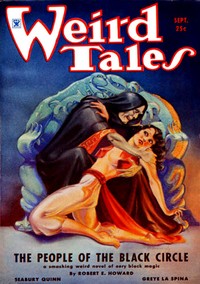
By Robert E. Howard
[Transcriber’s Note: This etext was first published in Weird Tales
September, October, November 1934. Extensive research did not
uncover any evidence that the U.S. copyright on this publication was
renewed.]
1 Death Strikes a King
The king of Vendhya was dying. Through the hot, stifling night the
temple gongs boomed and the conchs roared. Their clamor was a faint echo
in the gold-domed chamber where Bunda Chand struggled on the
velvet-cushioned dais. Beads of sweat glistened on his dark skin; his
fingers twisted the gold-worked fabric beneath him. He was young; no
spear had touched him, no poison lurked in his wine. But his veins stood
out like blue cords on his temples, and his eyes dilated with the
nearness of death. Trembling slave-girls knelt at the foot of the dais,
and leaning down to him, watching him with passionate intensity, was his
sister, the Devi Yasmina. With her was the _wazam_, a noble grown old in
the royal court.
She threw up her head in a gusty gesture of wrath and despair as the
thunder of the distant drums reached her ears.
‘The priests and their clamor!’ she exclaimed. ‘They are no wiser than
the leeches who are helpless! Nay, he dies and none can say why. He is
dying now–and I stand here helpless, who would burn the whole city and
spill the blood of thousands to save him.’
‘Not a man of Ayodhya but would die in his place, if it might be, Devi,’
answered the _wazam_. ‘This poison–‘
‘I tell you it is not poison!’ she cried. ‘Since his birth he has been
guarded so closely that the cleverest poisoners of the East could not
reach him. Five skulls bleaching on the Tower of the Kites can testify
to attempts which were made–and which failed. As you well know, there
are ten men and ten women whose sole duty is to taste his food and wine,
and fifty armed warriors guard his chamber as they guard it now. No, it
is not poison; it is sorcery–black, ghastly magic–‘
She ceased as the king spoke; his livid lips did not move, and there
was no recognition in his glassy eyes. But his voice rose in an eery
call, indistinct and far away, as if called to her from beyond vast,
wind-blown gulfs.
‘Yasmina! Yasmina! My sister, where are you? I can not find you. All is
darkness, and the roaring of great winds!’
‘Brother!’ cried Yasmina, catching his limp hand in a convulsive grasp.
‘I am here! Do you not know me–‘
Her voice died at the utter vacancy of his face. A low confused moan
waned from his mouth. The slave-girls at the foot of the dais whimpered
with fear, and Yasmina beat her breast in anguish.
* * * * *
In another part of the city a man stood in a latticed balcony
overlooking a long street in which torches tossed luridly, smokily
revealing upturned dark faces and the whites of gleaming eyes. A
long-drawn wailing rose from the multitude.
The man shrugged his broad shoulders and turned back into the arabesque
chamber. He was a tall man, compactly built, and richly clad.
‘The king is not yet dead, but the dirge is sounded,’ he said to another
man who sat cross-legged on a mat in a corner. This man was clad in a
brown camel-hair robe and sandals, and a green turban was on his head.
His expression was tranquil, his gaze impersonal.
‘The people know he will never see another dawn,’ this man answered.
The first speaker favored him with a long, searching stare.
‘What I can not understand,’ he said, ‘is why I have had to wait so long
for your masters to strike. If they have slain the king now, why could
they not have slain him months ago?’
‘Even the arts you call sorcery are governed by cosmic laws,’ answered
the man in the green turban. ‘The stars direct these actions, as in
other affairs. Not even my masters can alter the stars. Not until the
heavens were in the proper order could they perform this necromancy.’
With a long, stained fingernail he mapped the constellations on the
marble-tiled floor. ‘The slant of the moon presaged evil for the king of
Vendhya; the stars are in turmoil, the Serpent in the House of the
Elephant. During such juxtaposition, the invisible guardians are removed
from the spirit of Bhunda Chand. A path is opened in the unseen realms,
and once a point of contact was established, mighty powers were put in
play along that path.’
‘Point of contact?’ inquired the other. ‘Do you mean that lock of Bhunda
Chand’s hair?’
‘Yes. All discarded portions of the human body still remain part of it,
attached to it by intangible connections. The priests of Asura have a
dim inkling of this truth, and so all nail trimmings, hair and other
waste products of the persons of the royal family are carefully reduced
to ashes and the ashes hidden. But at the urgent entreaty of the
princess of Khosala, who loved Bhunda Chand vainly, he gave her a lock
of his long black hair as a token of remembrance. When my masters
decided upon his doom, the lock, in its golden, jewel-encrusted case,
was stolen from under her pillow while she slept, and another
substituted, so like the first that she never knew the difference. Then
the genuine lock travelled by camel-caravan up the long, long road to
Peshkhauri, thence up the Zhaibar Pass, until it reached the hands of
those for whom it was intended.’
‘Only a lock of hair,’ murmured the nobleman.
‘By which a soul is drawn from its body and across gulfs of echoing
space,’ returned the man on the mat.
The nobleman studied him curiously.
‘I do not know if you are a man or a demon, Khemsa,’ he said at last.
‘Few of us are what we seem. I, whom the Kshatriyas know as Kerim Shah,
a prince from Iranistan, am no greater a masquerader than most men. They
are all traitors in one way or another, and half of them know not whom
they serve. There at least I have no doubts; for I serve King Yezdigerd
of Turan.’



Comments
Loading comments…